Open Science, Open Access & DORA: How Are They Connected?
Open Access is an integral part of the concept of Open Science.
“According to Neuschäfer (2015), Open Science encompasses strategies and procedures that ensure openness, transparency, and reusability of all components of the scientific process. This means that not only scientific publications, but also research data (through open access and research data management), research software, and educational materials (through Open Educational Resources, OER) should be freely accessible under the Open Access model.”
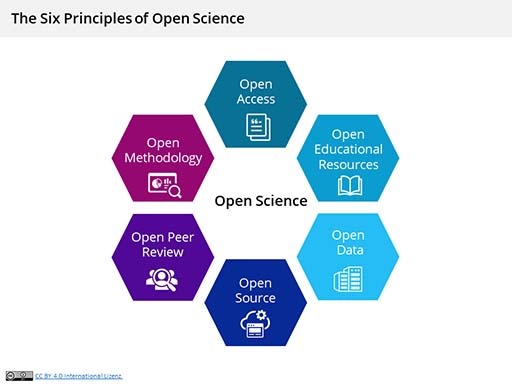
Therefore, Open Access is one of the six principles of Open Science.
Mechanisms for Ensuring Open Access
There are several mechanisms for ensuring Open Access. These can be conditionally divided into several levels:
- Policies and Regulatory Requirements
- Funder mandates (requirements to publish research results in Open Access).
- Institutional policies of governments and universities.
- Publishing policies regarding archiving and licensing.
- Principles of responsible research assessment, particularly DORA (San Francisco Declaration on Research Assessment).
- Open Access Models
- Gold
- Diamond
- Green
- Hybrid
- Repositories and Archives
- Licensing Mechanisms
- Infrastructure Tools
(DOI, ORCID, preprint platforms, etc.)
Therefore, Open Access is not merely an opportunity, but a system with established rules.
DORA
San Francisco Declaration on Research Assessment (DORA) establishes principles for evaluating scientific research outputs. Traditionally, when deciding whether to accept an article for publication, editorial boards monitor an author’s citation metrics, number of publications, and the impact factors of journals in which the author has previously published.
However, signatories of the DORA declaration commit to evaluating research based on its quality and impact, while considering context, methods, and the new opportunities provided by online publishing.
The San Francisco Declaration on Research Assessment is an international initiative that calls on journals to abandon the use of a single quantitative indicator for evaluating scientific articles.
Therefore, DORA principles emphasize that Open Access is not only about readers’ rights, but also about protecting authors’ rights.
Key Principles of DORA
- Do not use journal impact factor as a universal measure of quality.
- Evaluate the content and scientific value of the work itself.
- Evaluate and publish diverse forms of research outputs:
- data,
- software,
- peer reviews,
- influence on policy or society.
- Ensure transparency of assessment criteria.
Why Is Adherence to DORA Principles an Advantage for Authors?
- Fair assessment of scientific activity.
- Recognition of diverse research outputs — not only articles, but also open data, preprints, software, and other research products.
What Are the Benefits of Signing the DORA Declaration for Scientific Journals?
- Increased attractiveness of the journal to authors.
- Strengthening the journal’s reputation as a responsible publication.
- Improvement of editorial policies and greater transparency of the peer-review process.
- Increased trust from the scientific community and international partners.
- Better integration of the journal into the Open Science ecosystem.
How to Sign the DORA Declaration
The declaration can be signed electronically at: https://sfdora.org/sign/
Signing is free of charge and does not require any membership fees.
Signatories may include individuals, journals, organizations, publishers, and similar entities.
The declaration may be signed either on behalf of a journal or on behalf of a publisher.
- Editors, editors-in-chief, directors, journal managers, or individuals in equivalent positions may sign on behalf of a journal. Deputy editors, assistant editors, editorial board members, and similar positions may not sign on behalf of journals.
More information is available here: https://sfdora.org/sign/faq/
After signing, the journal or organization will be encouraged to announce this on its website, and the signatory’s name will appear on the DORA website.
Authors: Olena Herasymova, Dariia Melnyk.
We thank the open-access.network platform for the opportunity to disseminate and adapt its content for explaining the concepts and principles of Open Access.