What Are Research Data?
Research data refers to any information that has been collected, discovered, generated, or created for the purpose of validating original research results.
Research data may exist in various forms (digital and non-digital), including:
- Spreadsheets and documents.
- Audio and video recordings.
- Images and photographs.
- Questionnaires, test results, interview transcripts.
- Code and software.
- Laboratory notebooks, fieldnotes, diaries.
- Samples, specimens, and artifacts.
Scientific articles are usually based on research data, but the traditional paper format limited the ways in which data could be presented. Advances in technology have opened new opportunities to share data together with articles or even separately from them. This increases the credibility of conducted research and ensures reproducibility and opportunities for repeated reuse of results.
At the same time, the absence of data may lead to research findings being questioned and regarded as unverifiable.
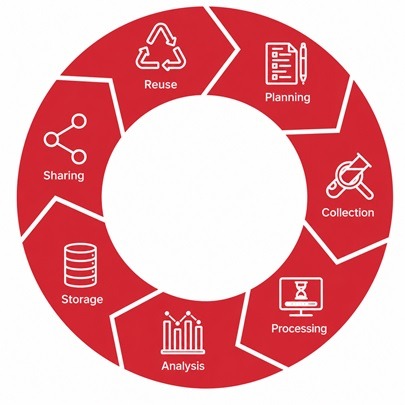
Throughout the entire research process, data must be managed properly.
This process can be described using the Research Data Cycle (RDC) presented below.
Research Data Management and FAIR Data
Research Data Management (RDM) is the process of organizing, depositing, and preserving data obtained during the implementation of a research project. Although effective data management may be challenging, it provides many benefits not only to researchers but also to the broader public. Some examples are below:
- Demonstrating the integrity of conducted research and strengthening the researcher’s reputation, which subsequently increases impact.
- Contributing to greater reliability and reproducibility of research.
- Helping to anticipate potential problems that may arise during the research process.
- Facilitating the writing and editing of scientific papers.
- Making data easier for others to find.
- Reducing the risk of article retraction due to confusion or incorrect data reporting.
- Reducing the risk of data loss.
If issues arise concerning a particular article, researchers will be able to defend their position or at least demonstrate that they reported their results in good faith.
Data Sharing. Research data management should always be carried out properly, but what are the best methods for sharing data? Not all data can be openly published — some research data contain personal or confidential information, while certain studies may additionally be protected by intellectual property legislation. There are also other valid reasons for restricting access to and reuse of research data. Taking these limitations into account, research data should be shared according to the principle “as open as possible, and as closed as necessary.”
Source of text and translated image: Introduction to Open Science: A Guide (pp. 14–20).
Text editing: Maryna Zhenchenko.