How work with scientific information is changing
Perplexity AI, Semantic Scholar and OpenAlex
How can you optimize your daily work with scientific literature and data? We introduce three free AI-powered tools that can transform your research workflow: Perplexity AI, Semantic Scholar and OpenAlex.
This article is based on the webinar “From Perplexity to OpenAlex: the digital toolkit of the modern researcher,” organized by the State Scientific and Technical Library of Ukraine on June 15, 2026.
Webinar speakers:
Svitlana Chukanova — Director of the Library of the National University of Kyiv-Mohyla Academy; certified Google for Education trainer.
Tetiana Yaroshenko — Deputy Director for International Cooperation in Science and Library Affairs at the State Scientific and Technical Library of Ukraine.
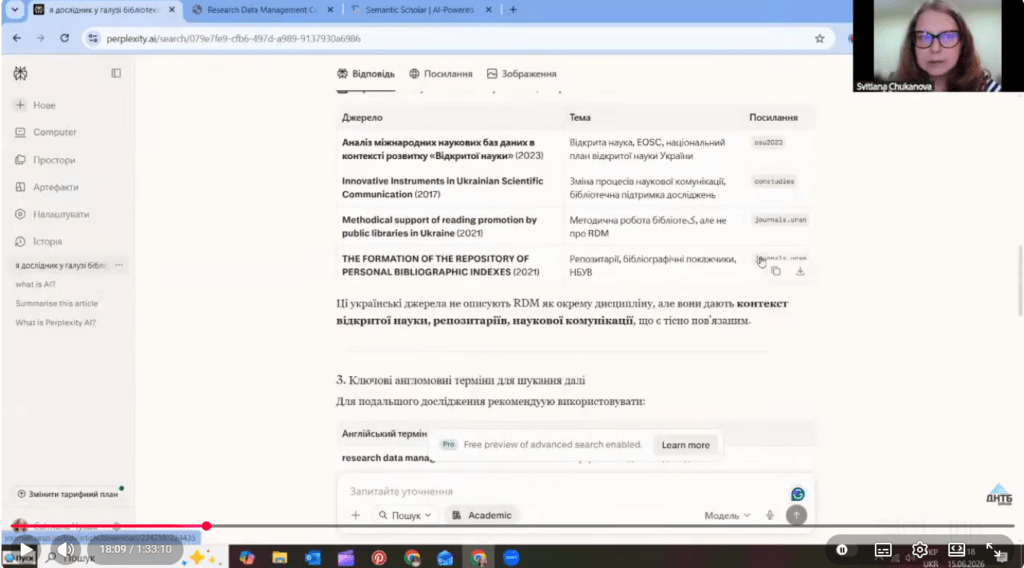
The key difference between Perplexity and many other AI services is that it does not fabricate references. Every statement is accompanied by a real source that can be verified immediately. For researchers writing a literature review, this is essential.
What can you do with it?
- Quickly map a research topic.
- Identify key debates in the literature.
- Find missing citations in your own manuscript.
- Compare different approaches.
- Generate structured tables of information.
But there is one important condition: you need to know how to formulate effective prompts. A vague query will produce a general answer. The Academic mode restricts searches to scholarly sources, improving the quality of responses.
The chat interface also allows you to continue the conversation in a consultant mode: narrowing the topic, asking follow-up questions, and requesting arguments from different perspectives. Perplexity is particularly effective for comparative queries.
Where is the boundary of academic integrity?
Using Perplexity to familiarize yourself with a topic, identify contradictions in the literature, discover missing citations, or work with sources in general is entirely consistent with academic integrity. However, copying AI-generated outputs directly into your work without verification or editing, or presenting them as your own original contribution, constitutes a violation of academic integrity.
Unlike Google Scholar, which primarily relies on exact keyword matching, Semantic Scholar has some ability to understand the context of a query and can retrieve relevant publications even when the wording is not exact. However, it performs best with English-language searches.
One of its major advantages is that it is completely free, with no paid subscription plans.
Key features:
TLDR — an automatically generated one-line summary of each article displayed directly in the search results. This saves time during the initial screening process because researchers do not need to open every publication to determine its relevance.
Semantic Reader — an integrated PDF reader that highlights key terms, displays pop-up definitions while reading and shows related publications in a side panel. This significantly accelerates work for researchers who regularly process large numbers of articles.
Citation Context — users can see who cited a publication and in what context, which is particularly useful when preparing a review.
Semantic Scholar also offers a free API for scientometric specialists and researchers conducting systematic reviews who require automated data collection.
OpenAlex is an open bibliographic database that aggregates data from Crossref, PubMed, ORCID and other sources. It contains more than 317 million works, provides a free API without registration requirements and is updated daily. Its coverage is broader than that of Scopus and Web of Science, particularly for non-English-language and regional journals.
For scientometricians and research analysts, OpenAlex is primarily a tool for institutional monitoring. It enables analysis of:
- The share of an institution’s publications across different open-access models (Gold, Green, Hybrid, Bronze, and Diamond).
- Trends in openness over time and across organizational units.
- Compliance with the requirements of Plan S and Horizon Europe.
Using the API, institutions can automatically generate quarterly reports without licensing fees or manual data exports.
For users who prefer not to write code, several tools are built on top of OpenAlex, including: VOSviewer for scientific network visualization, Bibliometrix in the R environment for bibliometric analysis, CWTS Leiden Ranking Open Edition for institutional rankings with customizable filters.
An important warning
Despite its many advantages, OpenAlex is not yet suitable for the full automation of scientometric calculations when citation-level precision is required. It still trails Web of Science and Scopus in the number of indexed references, meaning citation metrics are likely to be systematically underestimated.
Affiliation data are missing for a substantial share of publications, making institutional attribution more difficult, particularly for Ukrainian institutions, which have traditionally had lower visibility in international databases.
Some publications lack an identified source type, and author profiles often require verification. The system may create duplicate profiles for the same researcher or incorrectly assign publications to an author.
In practical terms, this means that OpenAlex is highly effective for monitoring trends, comparing institutions, analyzing open access and conducting systematic reviews. However, if you need an accurate h-index for a specific researcher or an official report for evaluation purposes, it is advisable to cross-check the results against Scopus or Web of Science. OpenAlex should be used alongside these databases, not as a complete replacement.
In reality, these tools do not compete. They complement each other at different stages of the research process.
- Perplexity is useful for initial orientation within a topic and for formulating research questions.
- Semantic Scholar is useful for more in-depth searching and analysis of specific articles.
- OpenAlex enables systematic data collection and large-scale scientometric analysis.
Together, they form a complete research workflow and all of it is free of charge.
Author: Oleksandr Shevchuk