DOI for scholarly publications:
answers to the most common questions
This guide explains how to register a DOI for your publication, who is responsible for the registration process and the required steps.
- What is a DOI?
- Why is a DOI needed?
- The Crossref Registration Agency
- The unit responsible for DOI registration at the University
- DOI for scholarly journals
- DOI for journal articles
- DOI for conference proceedings
- DOI for monographs
- DOI for textbooks, study guides and other educational materials
- What is important to understand about а DOI?
What is a DOI?
A DOI (Digital Object Identifier) is a unique permanent identifier assigned to an electronic document – a string of letters and numbers in the following format: 10.17721/XXXXX-XX/000-XX
DOIs are assigned to scholarly articles, monographs, conference proceedings, preprints and other publications.
Authors of scholarly publications are increasingly required to provide the DOI of their works.
Why is a DOI needed?
When the DOI string is preceded by the resolver https://doi.org/, it functions as “a unique hyperlink that provides direct access to the publication” (Danilova et al., 2019, p. 5).
A DOI not only identifies a publication but also makes it easier to locate online.
“A DOI functions as an embedded link – a code that helps locate any publication on any platform regardless of the language of the original citation, clearly identifies the location of the article on the Internet, and ensures a permanent and reliable connection between publications.” (Danilova et al., 2019, p. 5).
If the document’s URL changes (for example, due to website migration or repository restructuring) the DOI itself remains unchanged. The publisher or another organization that registered the DOI simply updates the URL in the DOI registry. As a result, resolving a DOI always directs users to the current version of the publication.
Important: A DOI may only be assigned by an authorized organization (a publisher, university, or repository) through official registration agencies, most commonly Crossref or DataCite.
The Crossref Registration Agency
“The agency is operated by the Publishers International Linking Association, Inc. (PILA). It is a non-profit organization whose membership is open to publishers of scholarly and professional literature. Members undertake to ensure that metadata for every object assigned a DOI are available in the digital environment.” (Danilova et al., 2019, p. 6).
“Crossref works only with publishers that have become members of PILA, paid the required membership fees, and received an official publisher code – the DOI prefix.
A PILA member may be a publisher producing a single scholarly journal as well as a research institution or academic publishing house.” (Danilova et al., 2019, p. 13).
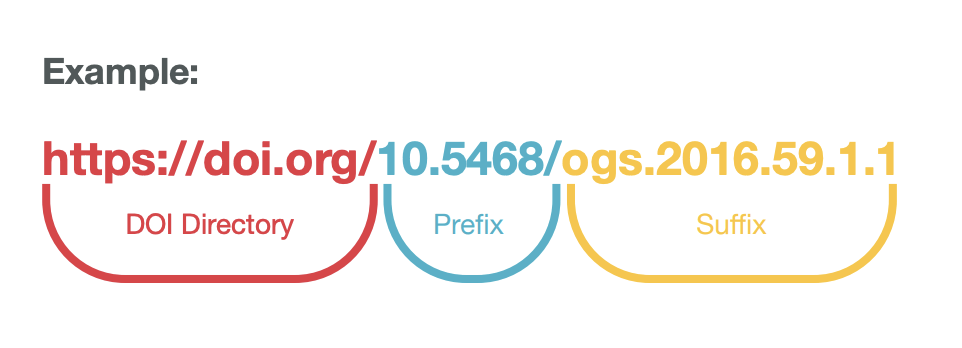
The DOI prefix assigned to the Taras Shevchenko National University of Kyiv is: 10.17721.
“The second part of the DOI, the suffix, is generated by the publisher according to established rules for each publication and every article within it.” (Danilova et al., 2019, p. 7). The suffix may consist of any alphanumeric string containing one or more elements.
For example:
- https://doi.org/10.17721/ISSN.year.journal issue.article number
- https://doi.org/10.17721/3845-4500.2016.2.01
- https://doi.org/10.17721/ISSN.year.journal issue.article pages
- https://doi.org/10.17721/3845-4500.2016.2.5-12
The DOI registration process at the Taras Shevchenko National University of Kyiv (the University) is described below.
The unit responsible for DOI registration at the University
The M. Maksymovych Scientific Library (the Scientific Library) is the University unit responsible for DOI registration and administration.
The Information Monitoring and Scholarly Publishing Support Service registers DOIs for:
- publications in printed scholarly journals that possess a registered print media identifier issued by the National Council of Ukraine on Television and Radio Broadcasting of Ukraine to the print media entity “Taras Shevchenko National University of Kyiv” (in accordance with Order No. 698-32 of August 20, 2025);
- University monographs and conference proceedings (in accordance with Order No. 371-32 of April 14, 2026).
DOI for scholarly journals
Each University scholarly journal has its own DOI identifier.
To register a DOI for a new scholarly journal, a formal submission requesting DOI assignment must be addressed to the Director of the M. Maksymovych Scientific Library. The submission must be signed by the Editor-in-Chief of the scholarly journal and the Dean (or Director) of the relevant University academic unit, and submitted through the ASKOD electronic document management system.
If the journal’s status changes (e.g., discontinuation, change of publisher, etc.) or the contact person responsible for DOI registration changes, the editorial office must notify the Scientific Library by submitting a request through ASKOD.
DOI for journal articles
DOIs for all articles within a journal issue are generated exclusively by the journal’s editorial office, while registration is carried out centrally through the Scientific Library.
Authors whose articles have been accepted for publication should not contact the Scientific Library directly to register a DOI.
The editorial office’s designated staff member follows the instructions and submits a request to the Scientific Library specialist responsible for DOI registration. The registration process typically takes 1–3 business days.
Responsibilities of the author
The journal is responsible for ensuring that all DOI links remain functional and direct users to the current webpages of publications.
The author should also verify that the DOI link is active and leads to the webpage of their own publication. If any problems are identified with the webpage display or DOI resolution, the author should contact the journal’s editorial office.
DOI for conference proceedings
A conference proceedings volume may be assigned a DOI with the University’s prefix provided that it meets the following criteria:
- the conference is included in the University’s annual schedule of scholarly events;
- the University is an official organizer or co-organizer of the conference;
- the full text of the proceedings and/or its metadata are available on a special webpage in the eKNUTSHIR institutional repository with open access;
- the publication contains complete and correctly formatted metadata in English in accordance with the DOI Assignment Procedure.
Step-by-step guide to obtaining a DOI for conference proceedings
- Verify that the publication meets the DOI registration requirements.
- Deposit the publication in the eKNUTSHIR repository.
- Complete all publication metadata in English.
– DOI of the conference proceedings
– author’s (authors’) first name, last name, and affiliation
– conference title
– conference abbreviation
– conference number
– conference dates
– conference venue
– conference organizer / sponsor
– title of the conference proceedings
– publisher / institution
– publication date
– ISBN (if available)
– ISSN (for a series, if available)
– link to the full-text electronic version in PDF format
- Generate the DOI suffix in accordance with the Scientific Library’s guidelines.
- Submit the publication for deposit in the eKNUTSHIR repository (once approved by the repository administrator, the publication will become publicly available and receive a permanent URL).
- Submit a DOI registration request: https://forms.gle/1CaprZBgQMzZEEP96
Important:
For a conference proceedings volume published by the University, only one DOI is registered.
The DOI link directs users to the corresponding eKNUTSHIR repository webpage, where the full text of the conference proceedings is available.
The DOI is assigned to the conference proceedings volume as a whole, rather than to individual conference papers, articles or other materials included in the volume.

Image source: AI-generated; DOI logo – https://www.doi.org/
DOI for monographs
A monograph may receive a DOI with the University’s prefix provided that:
- it has been published by the Kyiv University Publishing and Printing Center;
- at least one of the authors is affiliated with the University;
- the full text of the monograph and/or its metadata are available on a special webpage in the eKNUTSHIR institutional repository with open access;
- the publication contains complete and correctly formatted metadata in English in accordance with the DOI Assignment Procedure.
Step-by-step guide to obtaining a DOI for a monograph
- Verify that the publication meets the DOI registration requirements.
- Deposit the publication in the eKNUTSHIR repository.
- Complete all publication metadata in English.
– DOI of the monograph
– author’s (authors’) first name, last name, and affiliation
– title of the monograph
– publisher / institution
– publication date
– ISBN (if available)
– link to the full-text electronic version in PDF format
- Generate the DOI suffix according to the Scientific Library’s guidelines.
- Submit the publication for deposit in the eKNUTSHIR repository (after approval by the repository administrator, it will become publicly accessible and receive a permanent URL).
- Submit a DOI registration request: https://forms.gle/7LTpUje1qhjc7bUM6
DOI for textbooks, study guides and other educational materials
The author or the person responsible on behalf of the group of authors may register a DOI for a publication through repositories that provide DOI registration services. One such repository is Zenodo.
The following types of materials may be deposited in Zenodo:
- textbook;
- study guide;
- report;
- preprint;
- conference poster;
- presentation;
- educational video;
- lecture materials.
The work (or its metadata) must be deposited in the repository. Open access is not a mandatory requirement.
It is important to note that a DOI assigned through Zenodo will carry the repository’s own DOI prefix. In contrast, a DOI with the University’s prefix confirms the publication’s affiliation with the Taras Shevchenko National University of Kyiv.
A community of the Taras Shevchenko National University of Kyiv has been established in the Zenodo repository, where University staff and students can publish their works.

Access the TSNUK Community in Zenodo: https://zenodo.org/communities/tsnuk/records?q=&l=list&p=1&s=10&sort=newest
- To deposit a work in Zenodo through the Scientific Library’s service, complete the Google Form: https://forms.gle/WdBxoUmqLZgQ6e2U8
After the form has been submitted, a designated staff member of the Scientific Library will deposit the work in the repository.
- Those wishing to deposit their work independently may use the methodological guide: “Research data and preprints in Zenodo. How to publish in the Taras Shevchenko National University of Kyiv Community and obtain a DOI?”
What is important to understand about a DOI?
- One DOI corresponds to one digital object or one version of a digital object.
- A DOI is a permanent identifier. Once registered, it cannot be changed or reassigned to another publication. If an error is discovered, only the publication metadata or the destination URL may be updated.
- A DOI does not guarantee open access to the full text. It directs users to the publication’s webpage, where they can view its description and, depending on access conditions, read or download the full text.
- A DOI should always be cited as an active hyperlink, for example: https://doi.org/10.xxxx/xxxxx
- If the publication webpage is moved or its URL changes, the DOI should continue directing users to the correct page. To ensure this, the responsible institution must update the URL stored in the DOI metadata.
- Before registering a DOI, it is important to verify the accuracy of all metadata, including: publication title, author names, year of publication, publication details, publication webpage.
References: Danilova, A. D., Radchenko, A. I., & Yatskiv, T. M. (2019). Methodological recommendations for implementing digital identifiers in the publishing process for periodicals of the National Academy of Sciences of Ukraine. Publishing House “Akademperiodyka”, National Academy of Sciences of Ukraine.
Author: Olena Herasymova
Text editing: Alyona Mykhailenko